


THE KOTO
An ancient heritage, an emotion to experience today.
An iconic instrument of traditional japanese music
The koto is a large plucked zither belonging to an ancient family of stringed instruments originating in Asia. In China, comparable instruments, such as the zheng, had already existed for several centuries.
The koto is believed to have been introduced to Japan in the 8th century, during the Nara period. At that time, it was used primarily in court music, particularly in gagaku, the traditional music of the Japanese imperial court. The instrument experienced significant development during the Edo period (1603–1868), when new repertoires and schools of playing emerged.
Two major traditions remain particularly prominent today: the Ikuta school, which emerged in the 17th century, and the Yamada school, founded in the 18th century and distinguished in particular by its emphasis on the relationship between the koto and the human voice.
An instrument of subtle sounds
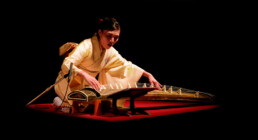
The traditional koto generally has thirteen strings stretched across a long soundboard made of paulownia wood.
Its slender shape has sometimes been likened to that of an elongated dragon.
Traditionally made of silk, the strings are now sometimes replaced with synthetic materials. They rest on small movable bridges, which the musician can reposition to determine the pitch of the notes and tune the instrument.
The koto is traditionally played while seated on the floor, with the instrument placed horizontally in front of the musician. The strings are plucked using three picks attached to the fingers of the right hand. On the other side of the bridges, the left hand presses down on the strings to alter their tension, creating variations in tone and subtle expressive inflections.
Beyond technical proficiency, learning the koto has traditionally been based on a close relationship between student and master. The process involves gradually assimilating the instrument’s characteristic posture, gestures, listening skills and sensitivity, while mastering a repertoire passed down from generation to generation. This learning process can lead to the awarding of the natori title, which recognises an advanced level of mastery and, among other things, allows the recipient to teach others.
Etsuko Chida: Preserving and bringing tradition to life
A koto player with the NIKA TAIKO ensemble, Etsuko Chida studied under several masters of the Yamada school.
At the age of twenty-one, she received the natori title, recognition of many years of dedicated study that also allows her to teach. Deeply committed to tradition, Etsuko Chida also helps introduce the koto to audiences beyond Japan. Her musical practice follows the lineage of the Yamada school, preserving its craftsmanship and repertoire.
In her performances, voice and instrument are intimately connected, engaging in a continuous musical dialogue. Their subtle harmony is one of the most demanding and expressive aspects of her art.

Her repertoire consists primarily of vocal and instrumental works from the 18th century and earlier periods, including pieces whose lyrics, written in classical Japanese, draw in particular on Japan’s poetic and literary traditions. Yet Etsuko Chida’s aim is not simply to reproduce music from the past. Her work helps keep this tradition alive for both Japanese and international audiences.
Through her playing, singing and commitment to passing on her knowledge, she preserves the techniques and repertoire of the Yamada school while bringing this heritage into the musical life of today.

The Koto at the heart of NIKA TAIKO
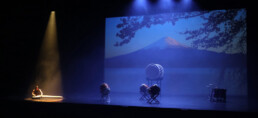
When the strings of the koto meet the Japanese drums, two sonic worlds come into resonance.
On one side, the deep resonance of the taiko, the force of each strike, and its physical, collective energy. On the other, the delicacy of the koto, the purity of its notes, its silences and its subtle nuances. Although they may seem worlds apart, the two instruments respond to one another with remarkable naturalness.
The koto brings a distinctive colour and a melodic dimension to the rhythms of the drums, while the percussion infuses it with renewed energy.
From this encounter emerges a rich sonic contrast, in which the delicacy of the strings blends with the power of the drums.
Within NIKA TAIKO, the koto thus opens up a new space for musical expression. It brings a different sense of breathing and a new depth, weaving a connection between the delicacy of each gesture and the collective energy of the taiko.
Through Etsuko Chida, the koto continues to carry a history, a set of techniques and a wealth of sounds passed down through generations, while finding its place at the heart of NIKA TAIKO’s contemporary creations.
An ancient heritage, a living tradition, a musical encounter that resonates today.